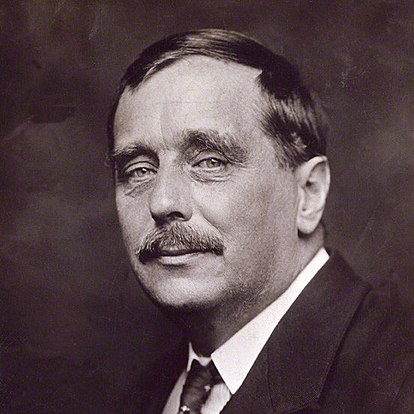
H. G. Wells
Herbert George Wells (21 September 1866 – 13 August 1946) was an English writer, prolific in many genres. He wrote more than fifty novels and dozens of short stories.
His non-fiction output included works of social commentary, politics, history, popular science, satire, biography, and autobiography. Wells' science fiction novels are so well regarded that he has been called the "father of science fiction". In addition to his fame as a writer, he was prominent in his lifetime as a forward-looking, even prophetic social critic who devoted his literary talents to the development of a progressive vision on a global scale. As a futurist, he wrote a number of utopian works and foresaw the advent of aircraft, tanks, space travel, nuclear weapons, satellite television and something resembling the World Wide Web. His science fiction imagined time travel, alien invasion, invisibility and biological engineering before these subjects were common in the genre. Brian Aldiss referred to Wells as the "Shakespeare of science fiction", while Charles Fort called him a "wild talent".
Books by H. G. Wells

Kipps: The Story of a Simple Soul
H. G. Wells

Short Fiction
H. G. Wells
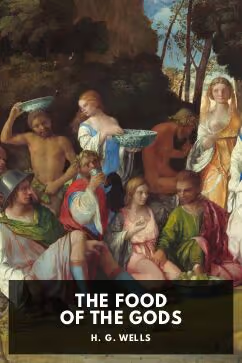
The Food of the Gods and How It Came to Earth
H. G. Wells
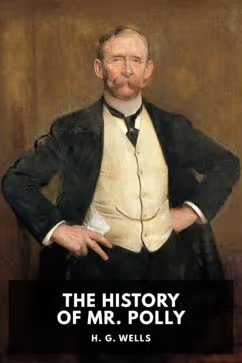
The History of Mr. Polly
H. G. Wells
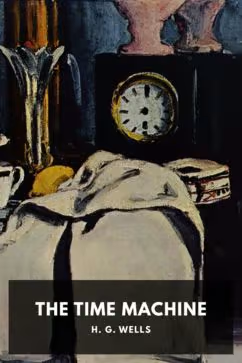
The Time Machine
H. G. Wells

The Wonderful Visit
H. G. Wells
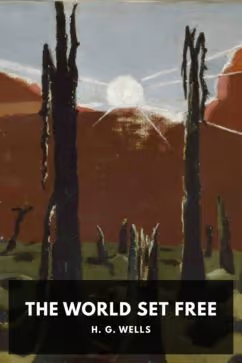
The World Set Free: A Story of Mankind
H. G. Wells

Tono-Bungay
H. G. Wells

The Island of Doctor Moreau: A Possibility
H. G. Wells

The War of the Worlds
H. G. Wells

The Invisible Man: A Grotesque Romance
H. G. Wells